
·
More projects coming soon
The Natural History series
The natural history of most species is often decontextualized, with many complex interactions governing nature’s habitats and ecosystems remaining overlooked. While concepts like biodiversity, trophic interactions, extinction, or the decline of keystone species are well-understood within the scientific realm, they rarely penetrate collective consciousness.
The ‘Natural History’ series takes on the challenge of elucidating these concepts by exploring the notion of scale in large organisms. The two-dimensional, life-size representations aim to draw attention to the physical reality of the depicted species by contextualizing them within the viewer’s daily human environment. These representations serve as an invitation to, in the words of poet and naturalist David Whyte, ‘the geography of the body and its conversation with the world.’
Physeter macrocephalus, 2011 (above left), preparatory drawing for Sphyrna mokarran, 2011 (above right).


Physeter macrocephalus, or the whale
This installation from 2011 is a painting composition on 971 A4 pieces of paper. It depicts a life-size sperm whale and was exhibited in the Portico of University College London as part of the 2011 Slade Degree Show.

Carcharias taurus, 2010 (top): 3.5 meters long Sand Tiger Shark, composed of 52 A4 pieces of paper.
Prionace glauca, 2009 (bottom): 2.1 meters long Blue Shark, covering 18 A4 pieces of paper.
Alejandro Cano · Doctor Cato
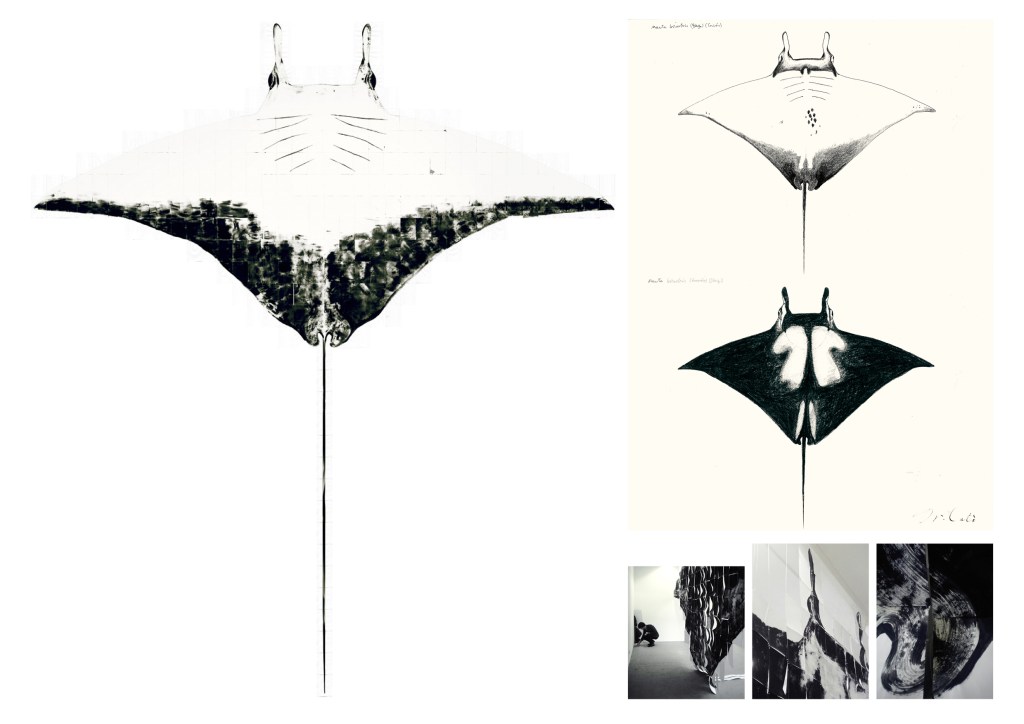
Manta birostris, 2011 (left): Life-size, double-sided, two-dimensional representation of a Manta Ray from 2011. A composition of 290 A4 pieces of paper.
(right) Two preparatory drawings of the dorsal and ventral views of a manta ray, and three photographs of the installation during the 2011 Slade Degree Show.

Architeuthis dux
A life size drawing of a giant squid (above) kept at the Museo Nacional de Ciencias Naturales in Madrid.
It is an ink drawing from 2005, done in different strips of recycled paper.
(below left) Quick sketch. (below right) Life size depiction of the internal anatomy of the giant squid, composed of 19 pieces of A4 paper.
Collosal / Giant Squid drawings

Mola mola
Life size painting from 2012 of an Ocean Sun Fish. It is a composition of 53 A4 units of paper. The size of the work is 2 x 2.5 meters.
Alejandro Cano · Doctor Cato

Cetorhinus maximus
This sculptural painting from 2010 represents the confluence of two work series: the ‘Natural History’ series and ‘Los Cachos’.
The two distal portions of the fish that are represented emphasize the importance of the missing section. The large size of the painting, more than 8 meters long, dramatizes the fragmentation. The void in the middle invites viewers to imagine the reconstruction of the whole. This work references the waste product discarded during seafood processing.
Cetorhinus maximus · Basking shark
 doctorcato.com